

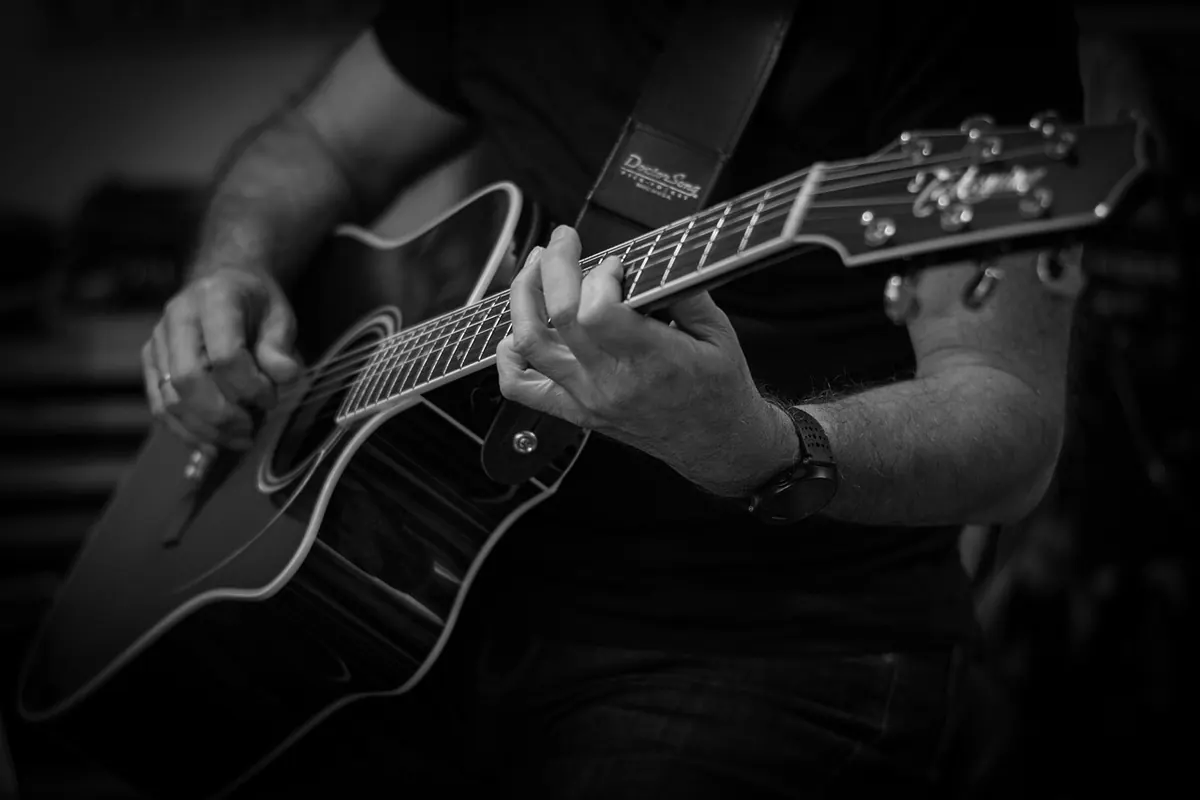
Every songwriter hits the same wall eventually: the chords work, the melody is decent, and the song still sounds like everything else you have written. One remedy sits in the tradition most of us half-know already — the ballads, modal tunes and dance rhythms that have circulated around Britain for centuries. The aim is not to write folk songs. It is to borrow the machinery: a narrative shape, a scale with a different gravity, a rhythm that carries its own accent. Those things push your writing somewhere it would not have gone alone.
Three things worth borrowing
The tradition offers three portable resources. The ballad supplies structure and narrative technique. Modal tunes supply melody and harmony that behave differently from the major and minor keys most of us default to. Regional dance music supplies tempo, accent and pulse. You can take any one of the three without touching the other two, which is what makes them useful rather than intimidating.
Ballads: steal the plot engine, leave the costume
Most British ballads sit on the same metrical frame: four-line stanzas alternating four stresses and three, usually rhymed ABCB or ABAB. That is common metre, and it is remarkably flexible. Broadside printers used it for centuries because any set of words in that metre would fit almost any tune in that metre. The tune was a slot; the words did the work.
The narrative habits are more interesting than the metre, though.
- Incremental repetition: a line returns with one detail changed, and the change is the story.
- Dialogue as plot: two voices carry the action while the narrator stays out of it.
- The delayed reveal: a name or a relationship held back until the final stanza.
- A refrain that explains nothing: a repeated line that sets mood rather than advancing events.
- Leaping over time: years pass between two lines because nobody needs to watch them pass.
Take a ballad like Barbara Allen. A young man dies for love, the woman he loved arrives, she hears the death bell, and she dies soon after. The song never explains why she refused him. That gap is the engine. You can lift that technique into an indie ballad or a country song: let the refusal stay unexplained, let the consequences arrive without commentary.
Try one of these in a song with nothing to do with folk music. Write a chorus that refuses to summarise. Let the last verse change a single word from the first. The effect is immediate and it costs you nothing.
Modes: a different centre of gravity
Modal tunes are where British traditional music sounds most obviously itself, and where the practical gains are largest. Dorian — a minor third with a raised sixth — gives you a melody that reads as sad but not defeated. Mixolydian — a major third with a flattened seventh — removes the leading note, so cadences feel open rather than closed. Pentatonic tunes, built on five notes with no semitones, can be harmonised several ways, which is part of why they travel so well between regions and instruments.
The drone test
Hold a drone on the root note and play your melody over it. If a note fights the drone, you have found the mode's characteristic interval. End a phrase on the second or the seventh chord instead of resolving home. Save the strong dominant-to-tonic cadence for the one moment in the song where you genuinely want the floor to close.
Sing a modal melody unaccompanied before you harmonise it. Harmonised too early, it tends to drift back towards the major key in your head.
Modes in practice
Listen for the mode in the wild. Scarborough Fair sits in Dorian, its raised sixth giving the melody a lift that stops it from becoming merely sad. The Cuckoo often uses a pentatonic scale, which is why it can be harmonised in several ways without breaking. She Moved Through the Fair leans on Mixolydian, its flattened seventh making the final cadence feel like a door left open. Once you hear these colours, you can use them as deliberately as a chord progression.
Regional rhythms: place has a pulse
Rhythm is the most local thing about a tradition. A jig in 6/8 has a lilting, three-against-two feel. A reel in 4/4 drives forward in even eighths. A hornpipe adds a dotted, swaggering step. A slip jig in 9/8 trips in threes. A Scottish strathspey uses the "Scotch snap" — a short note on the beat followed by a long one — to create a tugging, spoken quality. Each one carries an accent that is hard to mistake for any other place.
You do not have to write a jig to use this. Borrow the accent. Put the emphasis on the offbeat. Set a 4/4 lyric over a 6/8 pulse and let the two fight. Write a bass line that walks in hornpipe rhythm under a straight rock beat. A folk-rock arrangement of a ballad might keep the story in common metre but set it over a reel; the tension between narrative and dance pulse is the point. The rhythm tells the listener where the song comes from even when the words are yours.
How to borrow without pastiche
The fastest way to make this sound false is to treat tradition as a costume. You do not need to write in dialect, affect an accent, or pretend your song was collected in a field. Borrow the device, not the disguise.
- Use one folk device at a time. A modal melody is enough. A ballad structure is enough. Stacking every trick at once turns the song into a pastiche.
- Keep your own vocabulary. The tradition gives you shape and rhythm, not subject matter. Write about your life, your town, your breakups, your commute.
- Credit your sources. If you lift a tune, name it. If you rewrite a ballad, say so. Tradition is a conversation, not a free sample pack.
- Let the old and new clash. The interesting moment is when a 300-year-old narrative shape meets a modern image. Do not smooth that away.
A five-step exercise
If you want to try this on a song this week, here is a practical sequence.
- Choose a ballad in common metre, such as Barbara Allen or Matty Groves. Write down its plot beats in five lines or fewer.
- Rewrite those beats in your own setting. Keep the structure — the delayed reveal, the dialogue, the leap in time — but change the names, places and details.
- Sing your new lyric unaccompanied. Find the note that feels unstable against your voice. That is probably the modal colour you should keep.
- Set one phrase to a regional rhythm. Try 6/8 first, then 4/4 with a Scotch snap. Notice how the same words change character.
- Harmonise last. Record a bare voice version before you reach for a chord. If the melody only works with the chords, it is not carrying its own weight yet.
The point is not to become a folk musician. It is to let a deep local tradition remind you that songs can be built differently: stories can withhold, melodies can hover, rhythms can carry a place in their accent. Borrow one thing, then another. Your writing will stop sounding like everything else because it will have somewhere else in it.
Photo: connie_sf / Pixabay